Brokenness does not always indicate a problem, mistake, or failure. It can simply be an indication of transition, change, and renewal. When we look at ourselves and our relationships, we need to let go of the judgement of others which we’ve internalized. We need to once again see the beauty in brokenness rather than the failure.
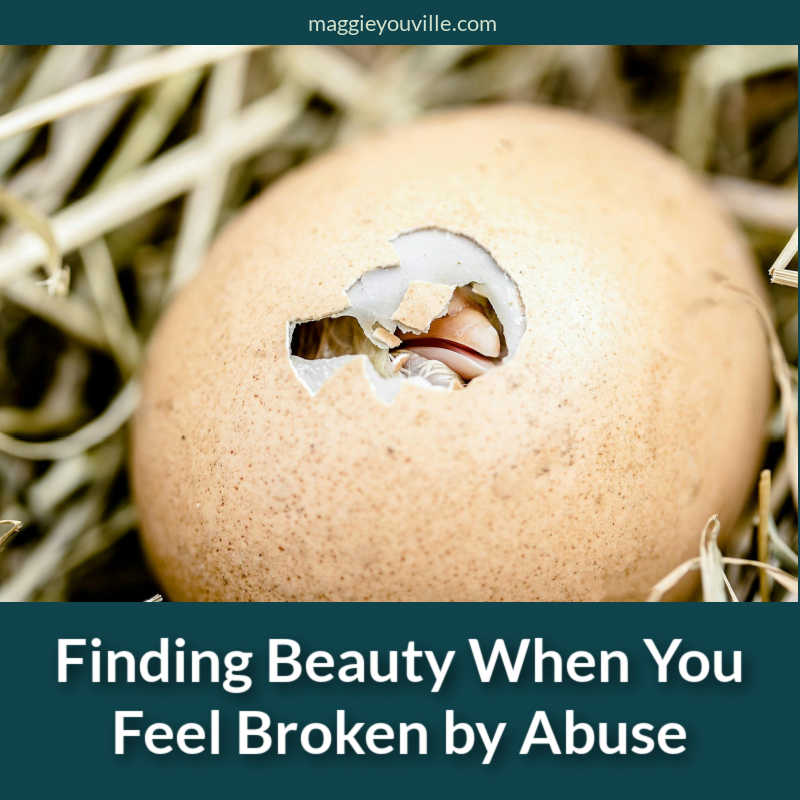
There have been many times in my years of being abused and trying to escape abuse that I felt broken, crushed, beaten. I’ve imagined myself as a bruised and limp flower, trampled underfoot. While this feeling of brokenness comes from the pain I’ve experienced, it doesn’t need to be my reality. Feeling broken can be an invitation to look deeper, to examine where this feeling comes from (childhood trauma? abuse? others’ judgement?) and to move towards growth and healing in that area.
Beauty in Brokenness
In the classic story Beauty and the Beast, one little chipped cup is distinguished from every other cup in the cupboard by his brokenness. This becomes his name, his value. Chip is well-beloved in every telling of the story. The TV show Once Upon a Time takes this even further. The story of how the cup is chipped is integral to the growing relationship between Belle and the Beast, a fond memory they share. The tea cup becomes one of their treasured possessions and shows up frequently through the show to remind them of their past. It also possesses a special magic in the story.
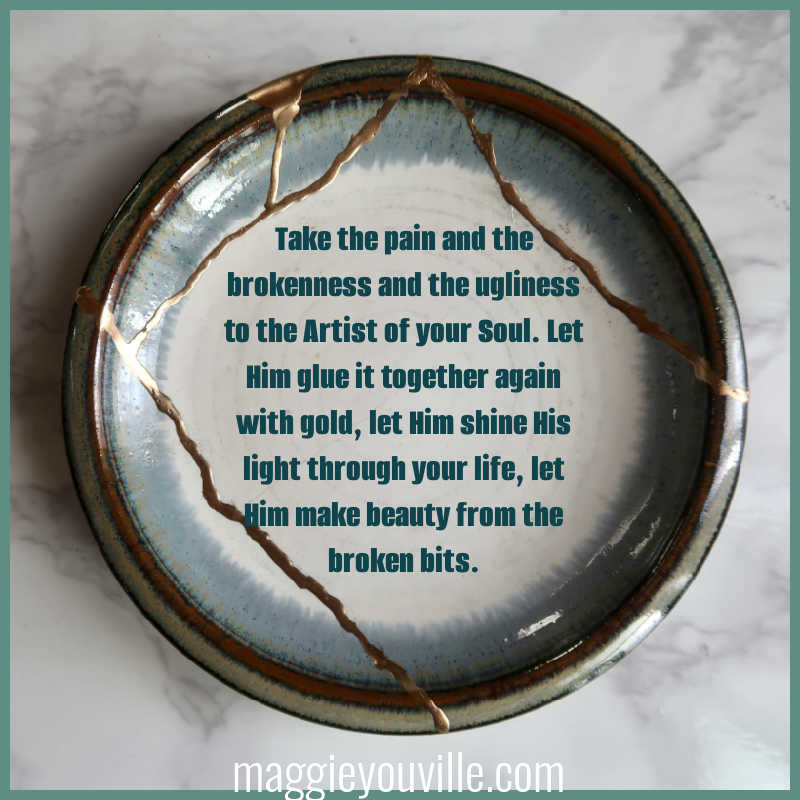
In Japanese culture, kintsugi or kintsukuroi is the art of repairing broken pottery using glue or lacquer dusted with gold. Breakage and repair is seen as part of an object’s history, rather than something to be disguised or something which devalues. Kintsugi highlights pottery’s story with precious metals, making the pottery even more unique and beautiful than it was before.
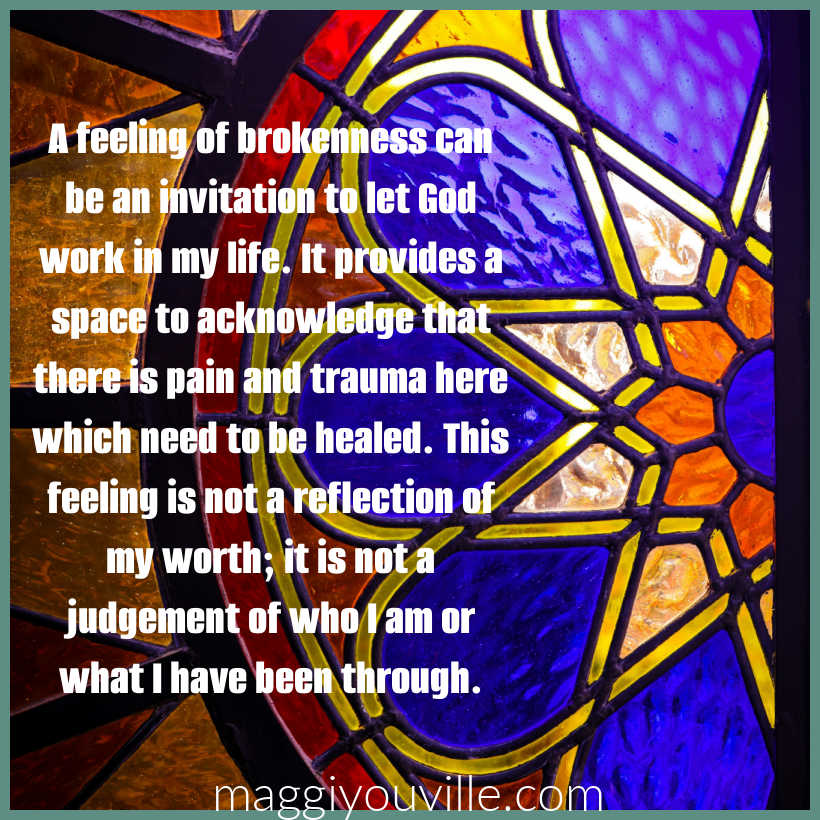
Stained glass windows and mosaics are other examples of creating art with broken pieces. Stained glass uses small pieces of broken glass to create beautiful, stunning images, which allow light to shine through to further illuminate both the brokenness and beauty. And yet we see only the beauty of the entire picture, not the individual brokenness of each piece of glass. Mosaics are made from broken pieces of tile, similarly pieced together to make something entirely new and intricate and unique.
In other areas of nature, we see that “breaking” leads to growth and new life. A chick cannot live without breaking its eggshell. A butterfly cannot fly without tearing its cocoon. We do not see either the empty eggshells or the empty cocoon as something bad or something broken; rather, we see them as evidence of life and growth and newness. We celebrate those things.
Brokenness is the Beginning of Growth
It was not my divorce that broke my marriage; it was the abuse I endured before the divorce which broke my marriage. I was not broken because of the abuse; I was still a beautiful, beloved daughter of God, created in His image and created equal to men. In many ways, it was the feeling of brokenness–shame, confusion, fear, damage–that pointed me to the abuse, to the problems in my marriage, and helped me realize, “This is not okay.”
Like a kintsugi bowl, I bear the marks of what I have been through. Like a stained glass window, I have often felt fragile and shattered even while I tried to let the light of God’s love shine in me and through me. Like a butterfly, I wanted to spread my new wings and fly high, but I felt others’ judgement pulling me back into that broken cocoon I’d left behind.
When I felt most broken, music reached out to me. I felt seen by Danny Gokey, who sings,
You’re shattered like you’ve never been before
The life you knew in a thousand pieces on the floor
And words fall short in times like these
When this world drives you to your knees
You think you’re never gonna get back
To the you that used to be
Yet Gokey does not leave us there on the floor in the brokenness. He lifts us into hope and healing with the next verse of the song:
Tell your heart to beat again
Close your eyes and breath it in
Let the shadows fall away
Step into the light of grace.
Yesterday’s a closing door
You don’t live there anymore
Say goodbye to where you’ve been
And tell your heart to beat again.
Turn to God in the Brokenness
A feeling of brokenness can be an invitation to let God work in our lives. It provides a space to acknowledge that there is pain and trauma here which need to be healed. This feeling is not a reflection of my worth; it is not a judgement of who I am or what I have been through. I do not have to apologize for my life in transition, my family evolving, my relationships re-imagined.
We can see examples of brokenness becoming beauty in construction sites all around our cities. Old, worn-out, broken-down homes are cleared away by heavy duty equipment to make room for new, neat, better homes. While the process is often messy and inconvenient, few construction crews apologize for that. We tolerate this season because we know what will come–a beautiful new neighbourhood, better homes, more shops. In our own lives and seasons of breaking down to rebuild we can give ourselves the same grace.
However, often when we face brokenness and pain in our lives, our human response is to lash out. We cannot see the beauty that is to come or the reason for this deconstruction or reconstruction, so we feel doubt and anger. We have been taught all our lives that God is good and God is love and God has a plan for us, so how can pain and problems be possible? Brokenness can hurt even more when it causes us to doubt the goodness of our Father God, as Tasha Layton shares:
My heart is breaking
In a way I never thought it could
My mind is racing
With the question, “Are you still good?”
Can you make something
From the wreckage?
Would you take this heart
And make it whole again?
It’s okay to sit in this discomfort, to acknowledge the wreckage and our questions. God is not afraid of questions; throughout Scripture, he shows up for those who question. And in the same way, as Tasha sings, he shows up for us, despite what we may feel:
Though the mountains may be moved into the sea
Though the ground beneath might crumble and give away
I can hear my Father singing over me
“It’s gonna be okay, it’s gonna be okay.”
This is not a superficial answer; this is not just a “shrug and move on” response. This requires a gut-deep trust in God, leaning hard into his assurance that it’s gonna be okay despite what we are feeling right now.
It’s gonna be okay because God is working in my life, in my relationships, in my family. It’s gonna be okay because, no matter the circumstances or the pain I’ve walked through, he has never seen me as broken; he sees me only as his beloved daughter. And with his help, I will let go of the judgement, the old-fashioned ideas, the inadequate language. I will provide myself and children with love, kindness, safety, dignity and safety. I will be tenacious, adaptive, and alive. I will be whole.
Look at Your Brokenness from God’s Eyes
Think of the process of creating a mosaic or stained glass window. Think of the artist gathering the broken pieces of pottery together and sprinkling gold dust in his glue. Think of the butterfly pushing out of its cocoon or the chick cracking its eggshell. These are seasons in our lives which are messy and hard, but they do not define us. Nor do we stay here in this ugliness. God calls us to trust in His work in our lives, in His plan, in the Easter Sunday that follows Good Friday.
For even Jesus faced moments of pain and doubt. In the Garden of Gethsemane, He looked at what was to come and shuddered. He didn’t want to walk that painful, humiliating, difficult road to Cavalry. Yet He knew that this was part of God’s plan and that even Friday could become “good” in the brilliant beauty of Easter Sunday. Easter would not mean the same without Cavalry. Just as God can bring a miracle from the cross, He can also bring a miracle from whatever you walk through in your life.
Take the pain and the brokenness and the ugliness to the Artist of your Soul. Let Him glue it together again with gold, let Him shine His light through your life, let Him make beauty from the broken bits.
Finding Healing Here
I hope my thoughts on brokenness and beauty have helped you to look at your own feelings of brokenness in a new way.
Take some time to journal about the thoughts and feelings this article has raised. Which image of brokenness becoming beauty do you most identify with? Consider finding some stock photos (like the ones above) to inspire you in this healing journey.
You may also find it helpful to draw or paint some of the images. You don’t have to be an artist to make art; if the idea of doing art is daunting to you, try starting with scribble art, which can look a lot like stained glass.
If music speaks to you, make a playlist of songs on your favourite platform. Here are some to get you started:
- “Tell Your Heart to Beat Again” by Danny Gokey (quoted above)
- “Into the Sea (It’s Gonna Be Okay” by Tasha Layton (quoted above)
- “Broken Things” by Matthew West
- “The Broken Beautiful” by Ellie Holcomb
- “When I Fall” by Katy Nichole
Leave a Reply