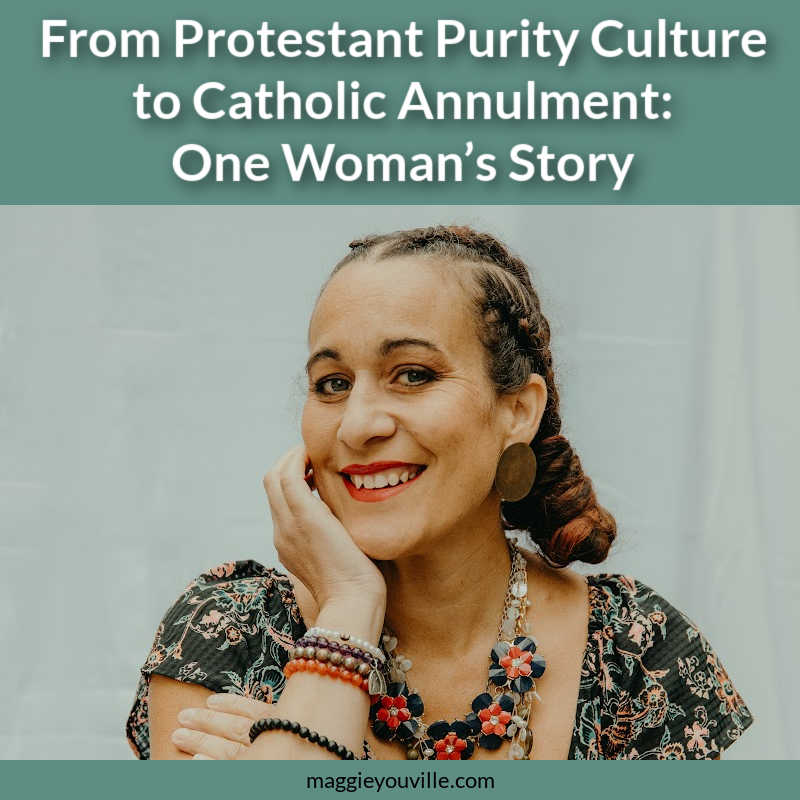
For many women, the annulment process is something they encounter only after a marriage has ended—a difficult process of sorting through questions about what happened and whether their marriage was valid in the eyes of the Church. But for one woman, that journey became intertwined with something much deeper: healing from childhood conditioning, an abusive marriage, and years of believing that staying was the faithful thing to do.
Raised in Protestant purity culture, she entered marriage after a courtship that left little room to truly know her future husband before saying “I do.” What followed was 19 years of escalating abuse, a gradual conversion to Catholicism that opened her eyes to what she had been living, and ultimately the courage to leave for the sake of her children. Three years after her divorce, she began the annulment process—not because she hoped to remarry, but because she wanted to entrust the question of her marriage’s validity to the Church.
Daja Gombojav’s story is ultimately one of survival, faith, and unexpected healing. In this interview, she shares what led her into marriage, what helped her recognize the abuse, why she stayed, how she finally found the courage to leave, and how the annulment process helped her confront both childhood and marital trauma.
This post contains affiliate links, meaning I may receive a commission at no extra cost to you if you click through and make a purchase.
MY: How did your relationship start?
Daja Gombojav: I was raised in what is now termed “Protestant Purity Culture.” My parents were early adopters of that movement. I wasn’t permitted to date, spend too much time with the opposite sex, and almost never had unchaperoned time with a boy. We were taught dating led to divorce. We were told that to hold hands, hug, or kiss someone you weren’t married to was tantamount to committing adultery, because that person may not be your spouse, but they are someone’s spouse… someday. God had one person picked out for you. If you gave away your heart to someone other than that one, the day would come when you would meet The One and you would not have an intact heart to offer them.
The alternative to dating is what they called Biblical courtship. This meant that if you consented to the relationship, you were mutually deciding that your relationship was bound for marriage. There was no context in which you could get to know someone or explore any emotional, spiritual, or physical intimacy unless the relationship was to end in marriage.
Therefore, I never dated my ex-husband. I met him very briefly and knew him for about a week before he called my parents and they had a conversation about whether I should marry him. They brought that decision to me.
In that moment, I had a semblance of choice. I could have said no. But I liked him and I couldn’t get to know him without saying yes. Plus, he was a missionary and a pastor. I had always wanted to a missionary. So it seemed kind of a no-brainer. I couldn’t get to know him better without consenting to a courtship bound for marriage anyway. Romance outside of marriage was “illegal” because the definition of marriage promulgated by leaders of the purity movement was “God’s means of legalizing romantic relationships.”
So, we entered into a long-distance courtship. He lived in Mongolia and I lived in California. We saw each other just once in three years, when my parents and I took a trip to Mongolia to meet his mother. We wrote letters and almost never called. It was too expensive in the 90s to make long distance phone calls and almost no one had the internet in their home.
After several years of writing letters, he flew back to the States on a 90-day visa. We had our first date (if you could call it that) a week before our wedding, which was 60 days after his arrival in the U.S. We had our first kiss as a couple on our wedding day. (This was also my first kiss ever. He had a very active sexual past, which he did not disclose to me before we got married.) We were the poster
couple for doing it “right.”
I loved him. He took me out of my parents’ house, plus he was a missionary so he was a means to an end for me. With him, I could accomplish my “calling” as a missionary.
But the problems started immediately, on our wedding night in fact, when I first experienced him being violent, controlling, and manipulative. The first time I thought “I must have made a mistake” was on our honeymoon. It was also on our honeymoon when I realized that he didn’t love me.
That only escalated in our 19 year marriage. We had 9 children together. I was very good at hiding the abuse, which originally was directed just at me, but then it spread to the children as they got older.
MY: What did you know about annulment before you got married?
Daja: Nothing. This isn’t a concept in my Protestant tradition.
MY: What helped you see the abuse?
Daja: The primary catalyst was converting to the Catholic Church. Only when exploring the Church’s teaching on human dignity, marriage, and sexuality did I realize that what I was living was nothing like the ideal. It was through the lens of the Church that I realized that not only was my marriage broken but the way I grew up was broken. I was broken.
My conversion was slow. It took a long time to undo the brainwashing I experienced as a child. I finally came fully into the Catholic Church 16 years into our marriage. By the time, we were no longer pastoring a church. My ex-husband had stopped practicing any faith whatsoever. We were living on a farm 3,000 miles from my family. My ex-husband wanted nothing to do with it and it caused a deep resentment in him.
I think he knew that in me choosing Christ, I was not choosing blind obedience to him. He threatened my life right before my confirmation on that Easter Vigil. I got ready through my tears anyway. Nothing was going to stop me from being received into the Church. He came to my Confirmation completely drunk.
Shortly after converting, I was working for a local parish and that priest was very casually but insanely insightful. One day, when I was experiencing car trouble in an ice storm and my ex-husband would not come help me, my priest asked, “Why is he punishing you?” I honestly never saw it that way until that moment. Then I could not see it otherwise.
All his actions were aimed at punishing me for daring to have a thought that he did not approve of or provide to me. He would often tell the kids and me, “If I wanted your opinion, I would give it to you.”
MY: What kept you there?
Daja: When you grow up in a charismatic Protestant context and are accustomed to “God told me XYZ,” it takes a lot of unraveling to change your course. Because one of two things must be true: 1) God was wrong about me or 2) I was wrong about God. Pull on either of those two threads and pretty quickly your world falls apart.
I stayed because I loved him and I believed at the time that this was “The One” God had for me. Plus, I had done everything right so God owed me the fairytale. I also stayed for the sake of the kids. I had been so conditioned to believe that children from broken homes were destined for lives of debauchery, crime, and apostasy. I thought they needed him in their lives.
About a year before we finally split for good, I did file a restraining order, but I lifted it two weeks later on the promise that we would get help and work things out. It never happened and the abuse escalated.
MY: What was the final trigger or motivation to get out and stay out?
Daja: When I saw my older children giving into despair, I realized their lives were really in my hand. I did not want to answer to God for how I had allowed them to be abused. They were going to lose their faith and their lives if I didn’t change something. So I made my husband leave.
At first, I thought perhaps it could be a temporary separation.
However, one day my 15-year-old, full of adolescent hurt and rage, told me his biggest fear was that I would forgive his dad and have him back in the home. He told me he didn’t plan to stick around to see that happen. So he planned to run away.
In that moment, I made him a solemn promise that I would never have his father back in our house. So, he unpacked his backpack and agreed to go to therapy with me. That fully solidified for me that the power to save my children was in my hands.
Had it not been for the kids, I may still be married to him. He had so eroded my self-esteem that I would have kept taking the abuse without question, believing I was being some kind of virtuous martyr for the sake of marriage. Thankfully, my maternal-heart was more fierce than any respect I had for myself. I got out for the sake of the kids and in the process saved myself.
MY: What helped you get out?
Daja: I was surrounded by very excellent priests, friends, and the Sacraments. One priest planned a safe house for me, which I never ended up needing because just the knowledge of it gave me the strength to make him leave.
During March of Lent in 2019, I stood in the very back of the confession line. When it was finally my turn, I sat in front of the priest and said, “Father, I am not looking for absolution today. I don’t even know what to confess. But I need prayer and I need to tell someone. Tomorrow, I am giving my husband an ultimatum to get sober and get help or I have to leave. And I’m scared. I believe my life is in danger.”
He listened. He prayed. He gave me a pastoral blessing. I cried.
The next day, I sent my children to a friend’s house and had my ex-husband alone. I made him a hearty meal. While he was eating, I sat on the rug in the living room and I gave him the ultimatum. I had 911 already dialed in case I needed to hit call. Instead of lashing out, he just sat in silence chewing. After a while, he said he wanted to stay.
For a week he was a dry drunk. Not drinking, but angry as hell. The tension and the violence increased. And I prayed. I prayed so hard every day, every moment. I drenched my pillow in tears. The kids and I would gather in the dark in my room and whisper the rosary. We had to whisper because if we prayed out loud he would become enraged.
Then, on March 30, I noticed signs he had been drinking again. So I confronted him and he did not deny it. He was defiant even.
I remember it as if it was yesterday. He was on a ladder and I was standing in the doorway. And time stood still.
I have never been a brave person. I’ve been a people pleaser, a fearful worrier, and timid rule follower. I was raised to never be an inconvenience and to never question authority. In that moment, I just stood there looking at him. The kids looked at me. Were we going to do this song and dance again? How many times? Was this just my lot in life?
Somewhere within me there flickered a tiny spark of divine grace. I heard myself saying, “That’s enough. You can go now.” I didn’t shout it. In fact, I think I said it rather meekly. But there was a new conviction that had never been there before.
He looked at me with disbelief. Perhaps he thought I didn’t mean it. But I did. Somehow in that moment I found my voice. I found I had a spine. I found a sure footing. I knew one thing and that was that this was enough.
He grabbed a duffle bag, shoved a random collection of clothes in it and as he walked out the door, he said, “Just so you know, you’re going to be alone always. You think your fancy church friends are going to care for you? I promise you they won’t. You’ll be alone forever and no one will care for you.” He threw his duffle bag into the back of his truck, flipped me off, and squealed out the driveway.
MY: Did questions about the validity of your marriage influence you to stay or go?
Daja: When we separated, I never intended to get divorced.
When we divorced, I had no intention of getting annulled.
When I got annulled, I had not intention of getting remarried.
In fact, I never had a glimmer of hope that I would get married again. All I wanted was to raise my children in peace. I never dated, never got a dating app, never even inquired into the annulment process. My only goal was to finish raising my children and then perhaps I’d join a convent.
I assumed my marriage was valid, but that wasn’t enough to make me stay with him. I wanted to be left alone for good.
My ex-husband and I split in March 2019. I didn’t apply for an annulment until a full three years later. When I did, it was at the encouragement of my friends who challenged me that I was thinking like a Protestant and relying on my own authority rather than trusting Holy Mother Church to sort it out for me.
They reasoned with me that if I was married validly, the Church would say so and I could be at peace knowing that he was my cross to bear even though I would never live with him again. If my marriage was not valid, the Church had the authority to release me and I could be at peace with that.
MY: When did you file for divorce and when was it finalized?
Daja: I filed for divorce in January of 2020. Then the pandemic happened and the courts all closed and everything went remote. So it was not finalized until March 2021. I began the annulment process in January 2022.
MY: Did anyone help you with the annulment process?
Daja: I had so much support. I had several priests, a Catholic therapist, and Franciscan hermit who (unofficially) provided spiritual direction. I also had my friends whose loving honesty had pushed me into applying for the annulment.
When I filed for divorce, I got so brutally sick I almost died and actually received Extreme Unction. I recovered by the grace of God and with the help of my best friend, who is a functional nutritionist.
MY: Did you find the process easy or difficult? Why?
When I applied for the annulment, I got sick again in such a dramatic way that it lead one of the many doctors who studied my case to ask me if I had been reading the book of Job.
Everything about the annulment was difficult: emotionally, physically, spiritually. But it was also one of the most radically healing experiences of my life.
My therapist told me, “I want you to consider that your body has stored a lifetime of trauma and violence. Perhaps your body is releasing it the same way it came to you. Very aggressively. But you are letting it go. It’s messy and painful, but your body is healing with your soul.”
Part of the healing from trauma was very physical and having the support of a trained functional and trauma-informed nutritionist was invaluable.
MY: When did you receive your annulment?
Daja: In the annulment process, the petitioner has an advocate who prepares a brief—a case against the validity of your marriage or reasons for the annulment. Then the file is sent to the Defender of the Bond—someone who plays the devil’s advocate, so-to-speak. This person argues for why your marriage is valid. Then both arguments go before the Tribunal for judgement.
This process takes a long time, but that is for good reason. I was content to wait because I had no plans to marry. I was told it could take upwards of 2 years. It took 7 months.
The “Defender of the Bond” in the tribunal process would not defend my marriage. There was nothing to defend. It was an open and shut case, not primarily because of my ex-husband’s mental condition, addictions, and alcoholism. Those issues were secondary. It was granted primarily because my upbringing in the cult-like-environment did not prepare me to be able to make an informed decision and
give full consent.
The Tribunal added a judicial monitum to my sacramental record. That is to say that before I could be granted permission to enter into a Catholic marriage, I would have to show proof to the Tribunal that I had received the necessary counseling for my past. My ex-husband was issued a judicial vetitum. In other words, I got a warning to deal with my trauma and he was forbidden to remarry.
MY: Do you feel the annulment was helpful in processing or healing your trauma?
Daja: Interestingly, the annulment process primarily healed my childhood trauma and then my marriage trauma.
MY: Did anything surprise you about the annulment process?
Daja: The questions I was asked were so specific and forced me to examine things I had never had the courage to deal with before. I discovered more about myself than I thought possible.
MY: Where are you now?
Daja: Initially, my ex-husband had joint custody and had the minor children every other weekend at his house. This went very poorly. So a few years later, the six older children went to court and testified against their father to protect the younger children from his violence and addictions. The court granted the motion to modify custody.
I now have full-custody and he can have supervised visitation at my discretion when he can show proof that he has gotten sober and has received counseling. He has chosen not to receive counseling or sobriety.
I got married a year ago—six years after splitting from my abuser. Marriage is beautiful in so many ways and cannot possibly be compared with my 19 years with my ex-husband. This is how it is supposed to be.
MY: Is there anything else you’d like to share with a woman who is preparing to apply for her annulment?
Daja: While searching through my old emails looking for something else, I found an email from a friend that said 8 simple words: “Don’t be a pussy. Fight for your kids.” I had to laugh. That blatant honesty saved my life and theirs.
You can do hard things. Keep your eyes on Jesus and lock in.
Also, try to practice detachment from the outcome. If you are not granted an annulment, accept it as God’s plan for your sanctification. If you are granted one, resist every urge to rush into another relationship. In fact, ask God for time to heal and to grow into your strongest and most confident self before you consider remarrying.
Remember that the goal in life is not to find a happy marriage. The goal in life is to become a saint. Run for heaven. An eternal perspective will help you not to drown in the details and mire of this life.

If Daja’s story has resonated with you, you may be interested in reading further:
- Recovering from Purity Culture: Dismantle the Myths, Reject Shame-Based Sexuality, and Move Forward in Your Faith
- The Life-Saving Divorce: Hope for People Leaving Destructive Relationships
- Come Awake Catholic Women’s Support Group (Facebook) – a place where Catholic women can find hope, support, and resources after betrayal.
Daja writes about healing, faith and more on her blog Reconciling Things. You can also find her on Instagram.
Leave a Reply